Currently Empty: $0.00
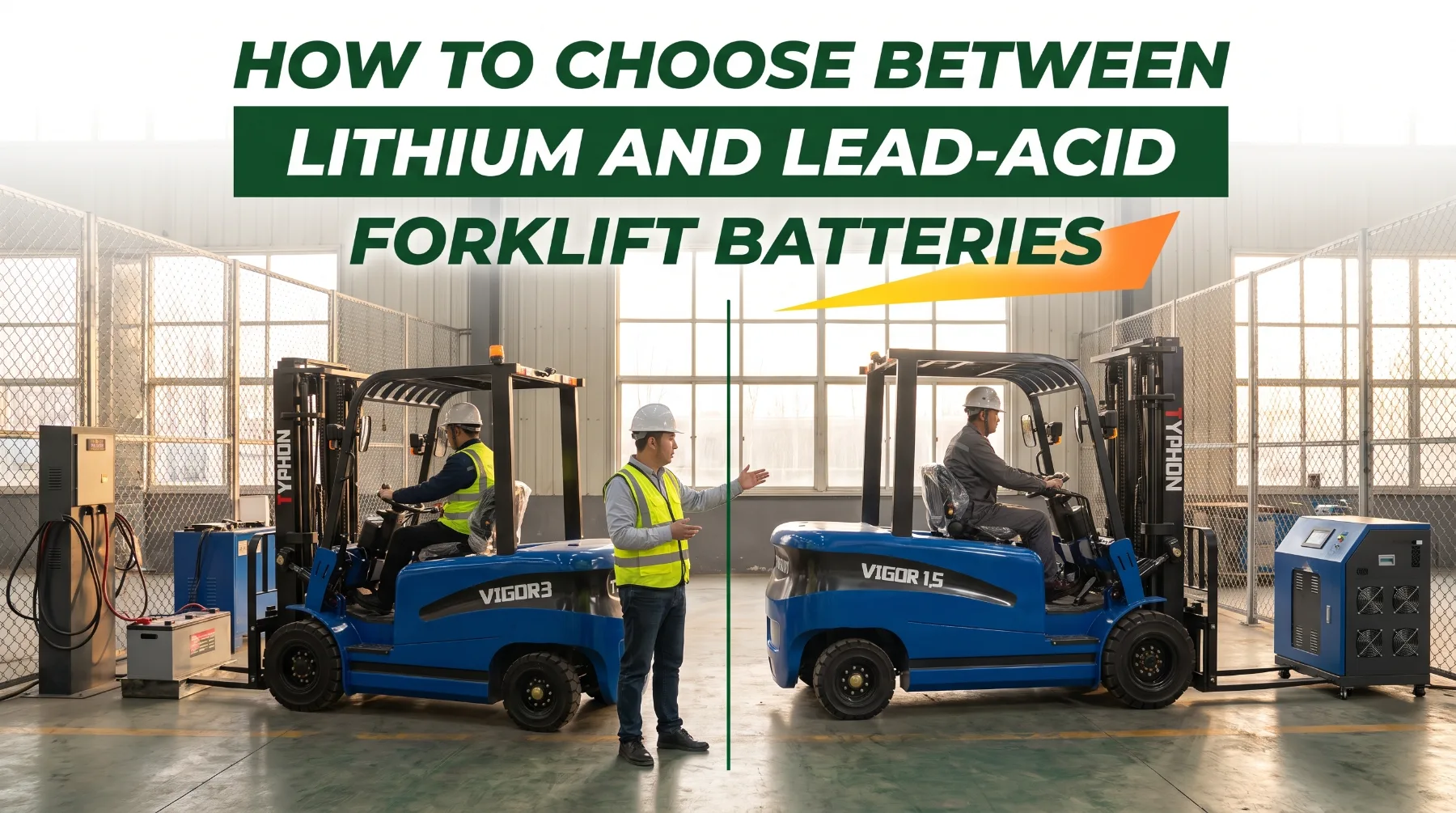
How to Choose Between Lithium and Lead-Acid Forklift Batteries
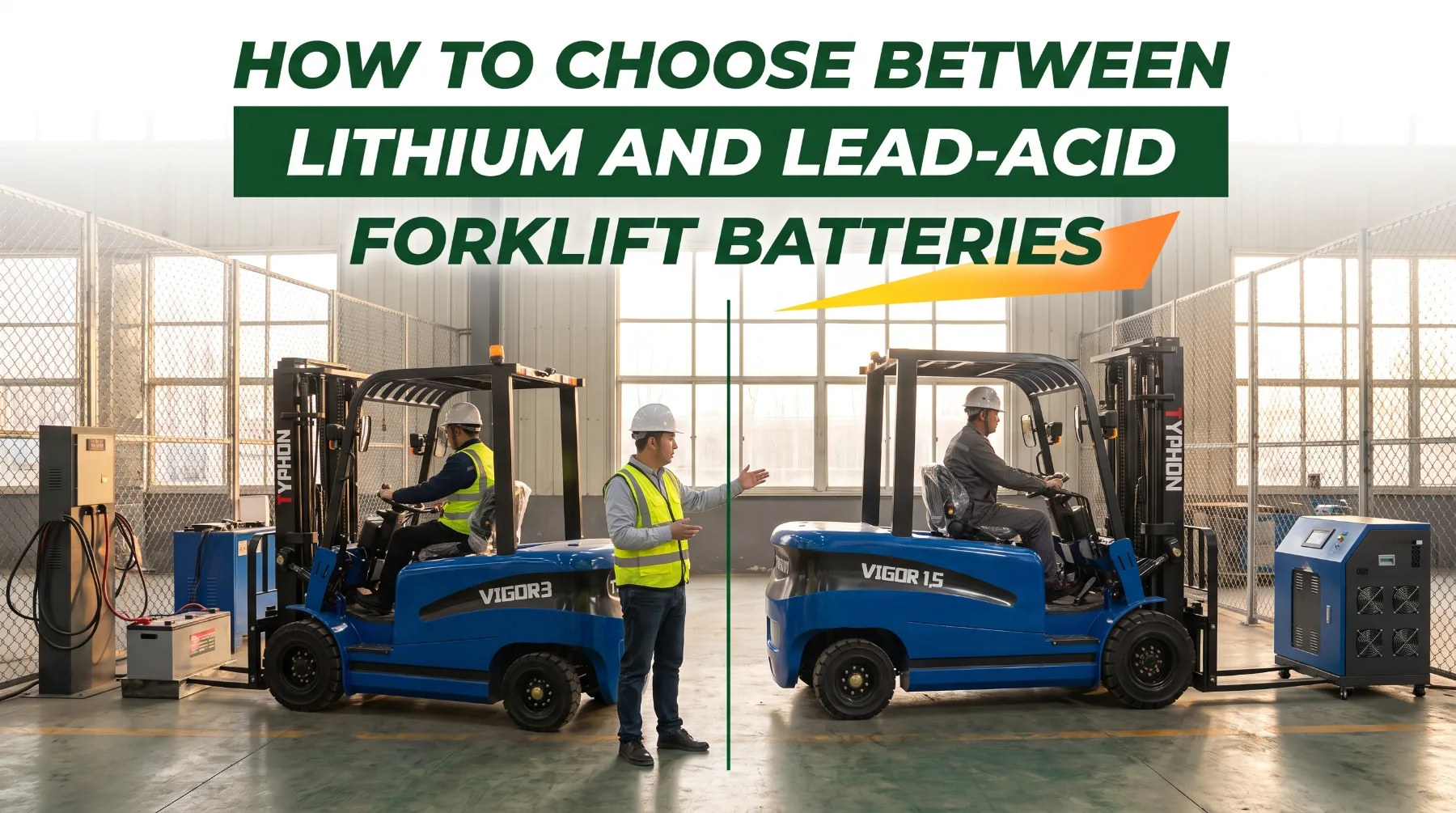
The battery in an electric forklift affects far more than how long the truck can run between charges. It influences charging time, shift scheduling, maintenance requirements, available floor space, and the total cost of keeping the fleet operating. Yet battery chemistry is often treated as an afterthought, with buyers simply choosing the same type they have used before. That can be a costly habit because lithium-ion and lead-acid batteries differ significantly in energy efficiency, charging behavior, maintenance, service life, and operating weight.
Choosing between them starts with understanding how the forklift is actually used. A single-shift operation may prioritize purchase cost and simple charging, while a multi-shift fleet may benefit more from fast opportunity charging and reduced maintenance. This guide compares lithium-ion and lead-acid batteries across charging, runtime, lifespan, maintenance, weight, operating patterns, and total cost, giving you a practical framework for selecting the chemistry that best fits your forklift fleet.
How Each Chemistry Works and What It Means for Runtime
Two very different technologies sit behind these batteries, and the difference starts at the chemical level. Lead-acid batteries generate power through a reaction between lead plates and a liquid sulfuric acid electrolyte. Lithium-ion batteries, most often lithium iron phosphate in forklifts, move lithium ions between electrodes in a sealed, far more efficient package. That contrast drives nearly everything that follows.
Usable capacity is where it shows up first. A lead-acid battery shouldn’t be discharged much past 50% of its rated capacity without accelerating wear, so half the number on the label stays effectively off-limits in daily use. Lithium-ion tolerates far deeper discharge, often down to 20% or lower, so a much larger share of its rated capacity does real work. The practical result: a lithium battery rated the same as a lead-acid one delivers noticeably more working energy per charge.
Voltage behavior adds to the gap. Lead-acid output sags as the battery depletes, so a truck can feel sluggish near the end of a charge, with lift speed and travel dropping off. Lithium-ion holds steady voltage almost until it’s empty, so the forklift performs consistently from a full charge down to the last usable percent.
Key takeaway: lithium-ion delivers more usable runtime per rated kilowatt-hour and steadier performance throughout the charge, while lead-acid locks away roughly half its capacity and fades as it drains.
Charging Behavior: Where the Two Diverge Most
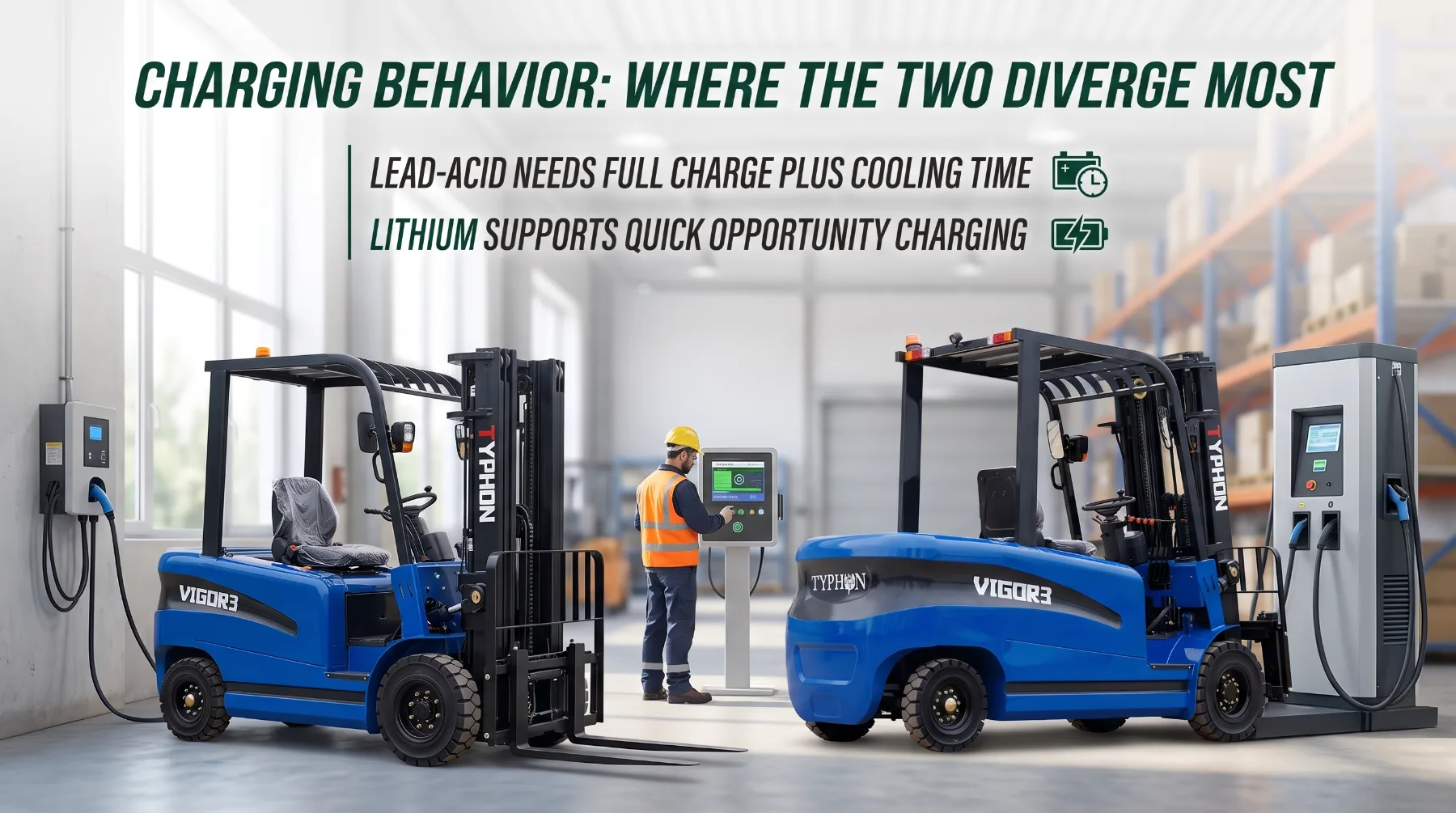
Charging is arguably the sharpest dividing line between these chemistries, and it reshapes how your day is structured. Lead-acid batteries need a full, uninterrupted charge cycle followed by a cooling period, and they require periodic equalization charges to keep the cells balanced. A typical cycle runs eight hours of charging plus several hours of cooling, which is why multi-shift lead-acid operations traditionally keep spare batteries and a dedicated changing station.
Lithium-ion changes the charging model by supporting opportunity charging, allowing quick top-ups during breaks, lunches, and shift changes. Short charging periods can keep the forklift ready throughout the day without requiring a full charging cycle or battery swap. Unlike lead-acid batteries, lithium-ion systems do not require the same cooling or equalization process, making them well suited to operations where the forklift needs to return to work quickly.
Downtime tells the story plainly. A lead-acid fleet running around the clock loses hours to swaps and needs floor space for charging racks and spare batteries. A lithium fleet folds charging into the natural rhythm of the workday, keeping trucks in service and reclaiming the space a changing room would occupy. For high-throughput operations, that recovered uptime often becomes the deciding factor.
Key takeaway: lead-acid demands full charge cycles, cooling time, and often battery swaps, while lithium-ion accepts fast opportunity charging that keeps trucks working and eliminates the changing room.
Total Cost of Ownership: Upfront Versus Long-Term
Sticker price and lifetime cost point in opposite directions here, and confusing the two leads buyers astray. Lead-acid batteries carry a considerably lower upfront cost, which makes them attractive on a first look and appealing when capital is tight. Lithium-ion commands a higher purchase price, sometimes two to three times more for a comparable battery.
The long view flips the math. Lithium-ion batteries last far longer, typically delivering two to three times the charge cycles of lead-acid before they need replacement. They charge more efficiently, wasting less energy as heat, which trims the electricity bill over thousands of cycles. They also cut labor tied to watering, swapping, and maintenance, and they remove the need for spare batteries and dedicated charging infrastructure. Add those savings across a five-to-ten-year horizon, and lithium frequently comes out ahead despite its higher entry price.
The honest answer depends on your usage. A light-duty, single-shift operation may never run enough cycles to recoup the lithium premium, making lead-acid the sound financial choice. A demanding multi-shift fleet running hard every day tends to reach the break-even point quickly and then bank savings for years. Run the numbers against your real workload rather than the purchase price alone.
Key takeaway: lead-acid wins on upfront cost, lithium-ion usually wins on total cost of ownership for busy fleets, and only your actual usage reveals which advantage matters more.
Performance Across Single-Shift and Multi-Shift Operations
Your shift schedule is one of the clearest factors in determining which battery chemistry fits the operation. A single-shift forklift that runs for about eight hours, takes normal breaks, and sits idle overnight can work well with lead-acid because the battery has enough time to recharge and cool before the next shift.
Multi-shift operations create a different demand. Running two or three shifts leaves less time for a full lead-acid charging cycle and cooldown, so the fleet may need spare batteries for swapping or accept charging-related downtime. That adds the cost of additional batteries, charging space, handling equipment, and labor, making lithium-ion more attractive when continuous operation is a priority.
Lithium-ion sidesteps the whole problem. Opportunity charging during breaks keeps a single battery topped up across back-to-back shifts, so one truck with one battery runs around the clock without swaps or spares. For continuous, high-intensity operations, that uninterrupted availability isn’t just convenient; it often determines whether the fleet can keep pace with demand at all.
Key takeaway: single-shift operations suit lead-acid comfortably, while multi-shift and round-the-clock work strongly favor lithium-ion’s swap-free, opportunity-charged endurance.
Maintenance Requirements for Each Type
Upkeep separates these batteries as much as anything on this list. Lead-acid batteries are high-maintenance by design. They need regular watering to keep the electrolyte at the correct level, and neglecting it damages the cells permanently. They require terminal cleaning to manage corrosion, periodic equalization charges, and careful handling of the acid itself, which brings safety and ventilation obligations. Skip these tasks and the battery’s life shortens dramatically.
Lithium-ion is effectively maintenance-free in daily operation. The sealed design needs no watering, no terminal cleaning, and no equalization. A built-in battery management system monitors cell balance, temperature, and charge levels automatically, protecting the battery and flagging issues without operator involvement. The labor hours a busy fleet pours into lead-acid upkeep simply vanish.
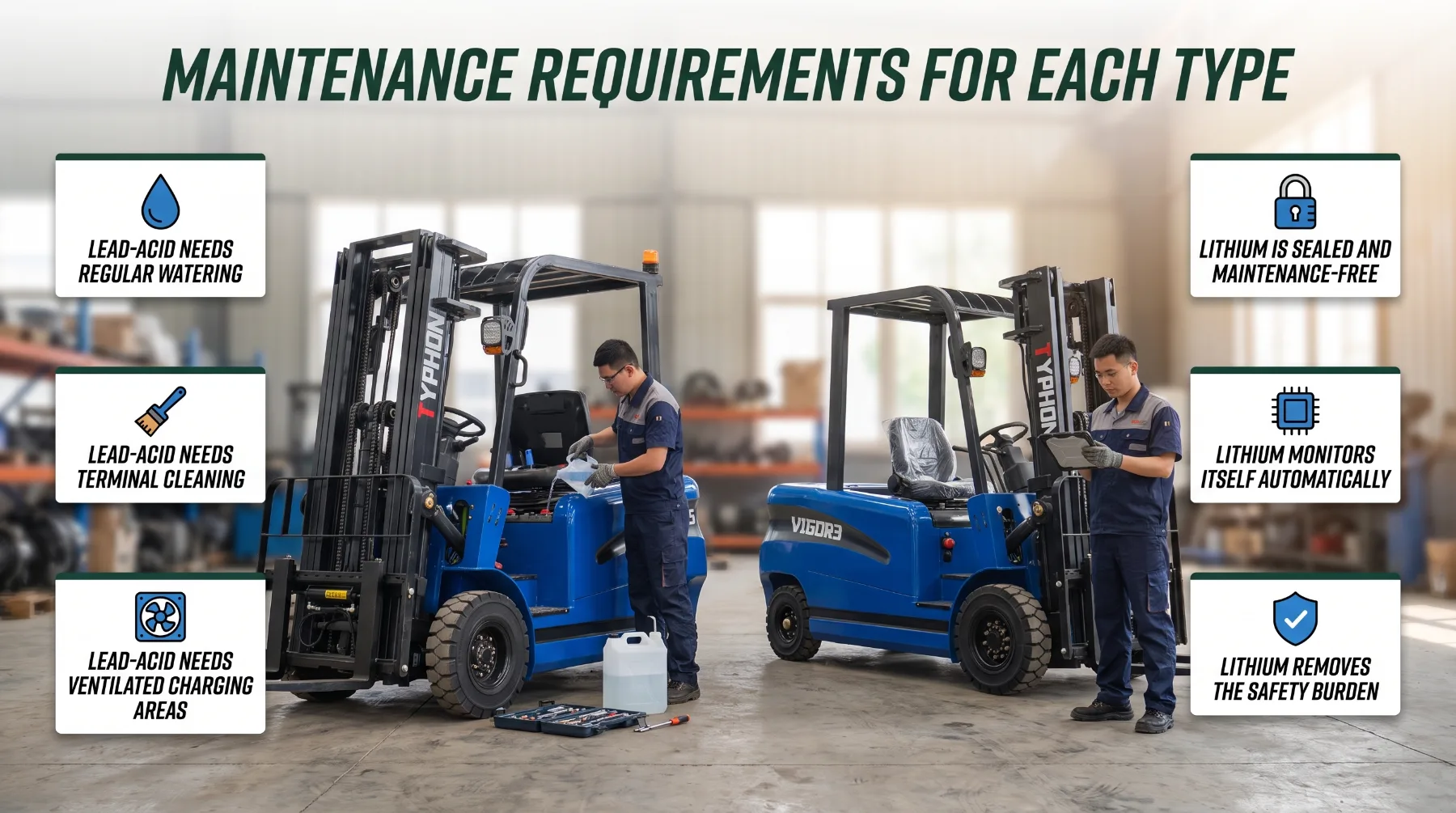
That difference carries weight beyond convenience. Watering and acid handling introduce safety risks and demand trained staff and proper facilities, including ventilated charging areas to manage the hydrogen gas lead-acid emits. Lithium removes those hazards along with the labor, which is why operations short on maintenance staff or wary of the safety burden often lean lithium even before the cost math.
Key takeaway: lead-acid demands ongoing watering, cleaning, equalization, and safety measures, while lithium-ion runs virtually maintenance-free under an automatic management system.
Weight and Counterbalance Considerations
Here’s a factor buyers routinely overlook: a forklift’s battery isn’t just a power source, it’s structural. Lead-acid batteries are heavy, and forklift designs deliberately use that mass as counterweight to balance the loads the truck lifts. The battery compartment and the machine’s rated capacity are engineered around that weight sitting low in the chassis.
Lithium-ion packs the same energy into far less weight and volume. That’s an advantage for efficiency, but it complicates a straight swap. Drop a light lithium battery into a truck built for a heavy lead-acid one, and you may lose the counterbalance the forklift needs to lift safely at its rated capacity. Manufacturers address this with steel ballast added to lithium packs, or with trucks purpose-built for the chemistry, so the weight and balance stay correct.
The takeaway for buyers is to treat weight as part of the decision, not a detail to sort out later. If you’re converting existing trucks, confirm the lithium battery is properly ballasted for that model. If you’re buying new, choose a truck engineered for the chemistry you want. Getting this right protects both safe operation and the load capacity you’re paying for.
Key takeaway: lead-acid weight doubles as essential counterbalance, so any lithium conversion or purchase must preserve proper ballast to keep the forklift safe and rated to lift.
A Practical Decision Framework
Selecting the right battery chemistry starts with understanding how the forklift fleet actually operates. The shift pattern is one of the first factors to consider. Single-shift operations with an overnight charging window can suit lead-acid batteries, while multi-shift or continuous operations may benefit more from lithium-ion. The workload matters too. Heavy, high-throughput use can make lithium-ion’s higher upfront cost easier to justify, while light and intermittent work may not require its additional capability.
Budget, facility space, labor, and operating conditions should be considered together. Lead-acid generally has a lower initial cost, while lithium-ion can offer advantages when long-term operating costs, reduced maintenance, and frequent charging are priorities. Limited charging space or labor can further favor lithium-ion, while established charging infrastructure can make lead-acid practical. Safety and ventilation requirements should be reviewed based on the battery system and facility setup.
Truck compatibility is another important consideration, especially when replacing batteries in existing forklifts. The battery must meet the truck’s electrical, physical, weight, and counterbalance requirements. Looking at these factors together helps prevent a mismatch between the battery and the operation.
Key takeaway: Match the battery chemistry to your shifts, workload, budget, facility, maintenance needs, and forklift compatibility rather than focusing on upfront price alone.
Conclusion
Lithium-ion and lead-acid batteries each suit different forklift operations, so the better option depends on how the truck is used rather than on battery technology alone. Lead-acid can make sense for single-shift, budget-conscious fleets because of its lower purchase price and established technology, while lithium-ion is better suited to demanding multi-shift operations that benefit from more usable capacity, faster opportunity charging, and minimal routine maintenance. Lithium-ion can also provide steadier performance and lower total operating costs over time, although its higher upfront price requires a larger initial investment. Lead-acid systems require regular maintenance, charging time, cooling periods, and often battery swapping, while lithium systems can be recharged during planned breaks when the operation allows it. Battery weight must also be considered because it contributes to the forklift’s required counterbalance, so any replacement must remain compatible with the truck’s specifications. Before deciding, evaluate your shifts, workload, charging opportunities, budget, and operating environment, then match the battery chemistry to the way your fleet actually works.
Frequently Asked Questions
Is a lithium-ion forklift battery worth the higher upfront cost?
For busy, multi-shift operations, it usually is. Lithium-ion lasts two to three times as many charge cycles as lead-acid, charges more efficiently, and eliminates the labor and infrastructure tied to watering, swapping, and maintenance. Those savings often outweigh the higher purchase price over a five-to-ten-year span. For a light-duty, single-shift operation that runs relatively few cycles, though, lead-acid’s lower entry cost may never be recouped. The right answer depends on how hard and how many hours your fleet works, so compare total cost of ownership against your actual usage rather than the sticker price alone.
Can I put a lithium battery in a forklift designed for lead-acid?
Sometimes, but it must be done carefully. Lead-acid batteries are heavy, and forklifts use that weight as counterbalance to lift safely at their rated capacity. A lighter lithium battery can upset that balance, so a proper conversion uses a battery with added steel ballast sized for your specific truck, or a machine engineered for lithium from the start. Never assume a straight swap is safe. Confirm counterbalance and compatibility with the manufacturer or a qualified supplier before converting, to protect both safe operation and the load capacity you rely on.
Why does opportunity charging work for lithium but not lead-acid?
Lithium-ion batteries tolerate frequent, partial charges without harm, so topping up during breaks and shift changes actually suits them and keeps trucks running all day. Lead-acid batteries are different: they need a full charge cycle followed by a cooling period, along with periodic equalization to keep cells balanced. Repeated partial charging without those full cycles degrades a lead-acid battery quickly and shortens its life. That’s why lithium fleets fold charging into the natural rhythm of the workday, while lead-acid fleets rely on full overnight charges or spare-battery swaps.